

The work of an exhibition doesn’t end when it opens.
If anything, that’s when it begins.
After an opening weekend, when those who attended the receptions and public programs go home and the press attention begins to fade, the real labor of cultural work comes into focus, including the work of getting people to visit the museum and see the art. This is when conversations deepen, listening sharpens interpretation, and sustained attention allows meaning to unfold over time.
Cheech Marin often reminds me how important it is to see art in person. Not as an image on a screen, not as a caption or a checklist, but as something encountered in space, with time. Standing in front of a work changes how we read it, and just as importantly, how we talk about it. That reminder stayed with me throughout the opening weekend of Chicano Camera Culture: A Photographic History, 1966-2026 at The Cheech, not only as a viewer, but as someone providing services to elevate awareness of the exhibition, working alongside artists, curators, and museum staff to help the work be understood and to draw audiences to see it.
Being present matters. For artists, for audiences, and for those of us behind the scenes doing the work around exhibitions, presence is not a luxury. It’s part of the job. Seeing art in person is essential, but so is being present for the conversations around it: listening to artists, hearing curators and museum educators speak about the work, and attending public programs where meaning is articulated collectively, in real time. These moments reveal what press language alone cannot. Meaning shifts when you slow down enough to notice what can’t be captured in a single image or media release.
Another part of the work that begins after an exhibition opens is communication, not as logistics, but as infrastructure. Clear, consistent, and timely communication across curatorial and museum teams, artists, lenders, and supporters is essential if the work is going to be understood, supported, and sustained over time. When communication falters, it doesn’t just affect schedules; it affects how we effectively advocate for artists and their work, align our messaging, and support our goals, both institutionally and from the perspective of the artists.
This is the kind of work that happens after the opening: the work of looking more closely and carrying what you’ve learned forward. It is quiet work, often unnoticed, but it is happening, and it is essential.
I was reminded of this most clearly while spending time with the work of artist Yulissa Mendoza (they/them), whose sculptural installation involving photography, Vamos al Licor, is included in Chicano Camera Culture. Curated by renowned Latinx photography scholar Elizabeth Ferrer, the exhibition is on view at The Cheech through September 6, 2026 before embarking on a national tour (full disclosure: I am managing that tour!).
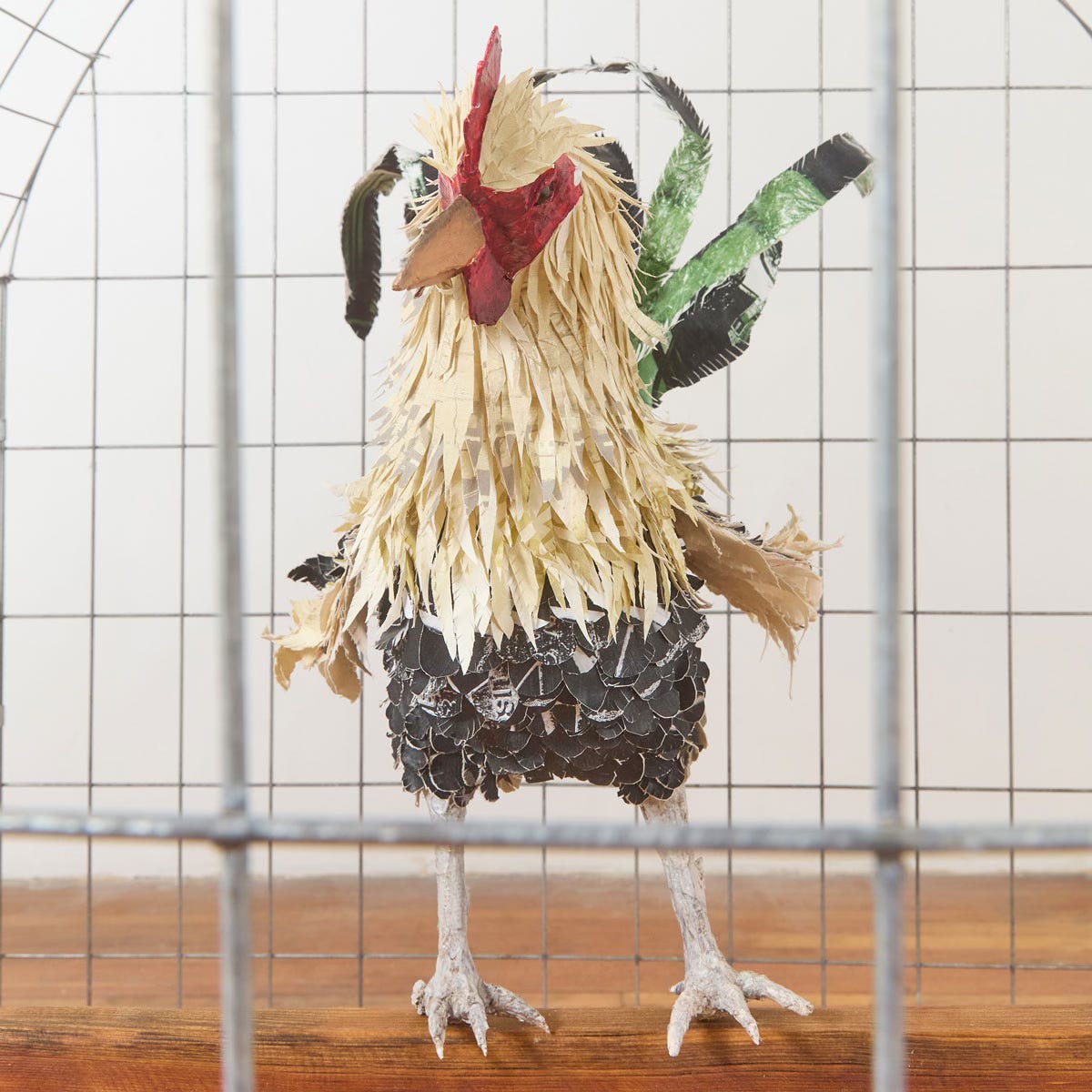
Before seeing Mendoza’s work in person, I thought I understood it (and I needed to understand it so I could do my work to promote the exhibition). From images alone, I assumed I was looking at a framed photograph. It wasn’t until I stood in front of the work at The Cheech that I realized it was a constructed photographic installation: something spatial, material, and resistant to documentation.
That distinction matters.
Mendoza’s practice reflects a shift away from traditional photography toward photographic installation, with image-making that is not just about representation, but about space-making. They create work for people to experience a place that is often passed by without being seen. Mendoza’s work centers on a place where they grew up: Muscoy, an unincorporated community in San Bernardino County, California. It is a place many drive past without knowing it is there, and one that is changing rapidly.
Mendoza became more aware of time passing after experiencing several personal losses. Over time, documentation became more urgent, alongside an awareness of inevitability and change. They spoke about being forced to accept that the space they are recording is already being gentrified, and that it may not exist in the same way just a few years from now. Sometimes that story is carried through people, sometimes through landscape, but always through place, through what is seen, heard, and remembered.
Mendoza’s work on view at The Cheech is the second in a series of three sculptural roosters, each constructed from photographic archives and layered sound. Together, they form a living timeline. The rooster becomes both subject and symbol, drawn from Mendoza’s childhood memories of their grandparents’ ranchos in Muscoy and earlier in Mexico, where roosters marked the rhythm of daily life. They were the wake-up call. A signal to feed the animals. Another day to work the land.
Sound is central to this work. The first rooster included only the sounds of roosters; part warning, part love letter. The second layers those familiar sounds with encroaching industrial noise. The third, still to come, will feature only industrial sounds: a full-circle moment that marks the closure of a way of life shaped by gentrification and development.
Mendoza wants to preserve these disappearing soundscapes now. The smells, the animal calls, the ambient life of Muscoy are often the first things visitors notice and the first things to be lost as warehouses and logistics infrastructure overtake the Inland Empire. Their installations become an archive for a different kind of audience: one attuned to rasquache aesthetics, to community memory, and to preservation that does not extract, but replicates.
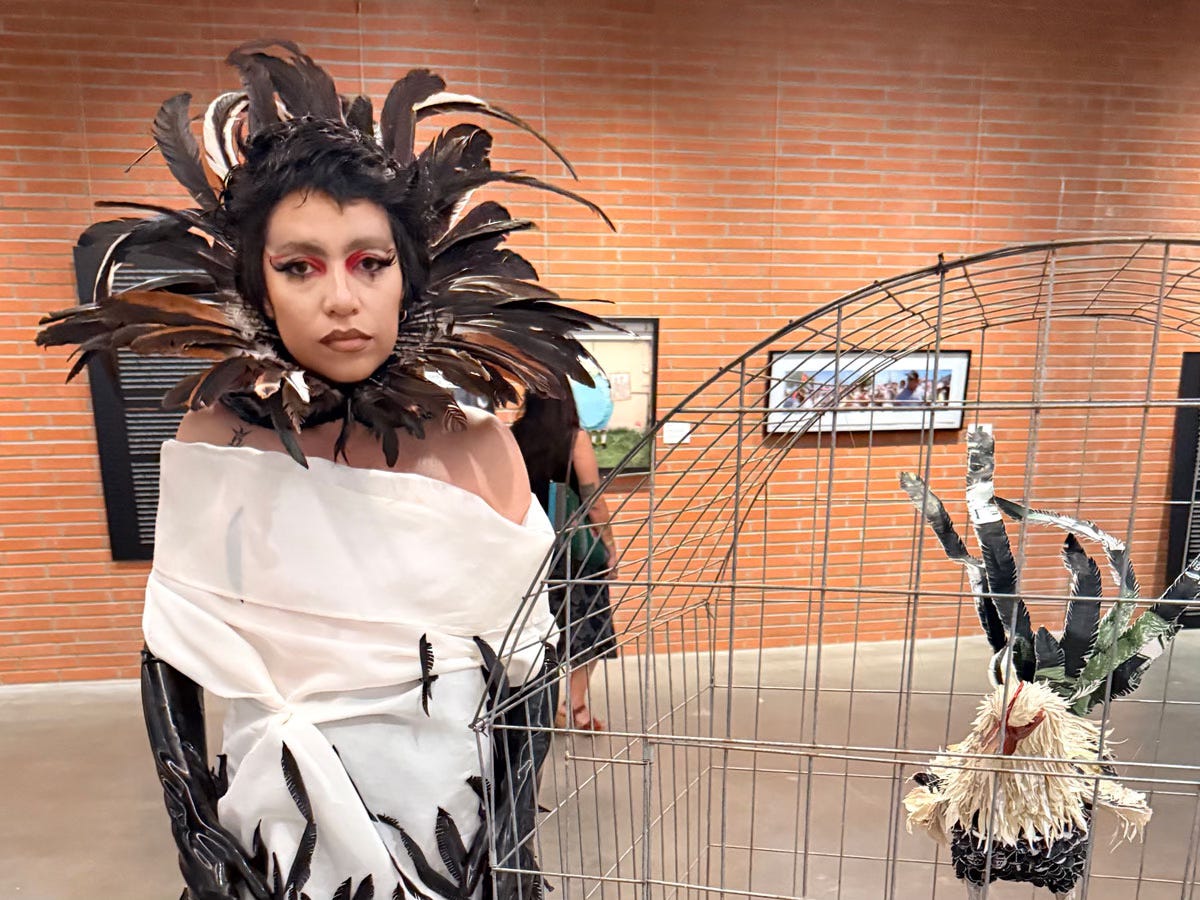
Even what Mendoza wears is part of that world. At the opening, Mendoza wore a collar made from rooster feathers collected during molting designed by artist Perry Picasshoe. It was not adornment for its own sake, but it was storytelling. The large neckpiece functioned as a wearable extension of the work displayed in the gallery itself. From across the room, people could see them, approach them, and ask questions. The conversation began before a word was spoken.
Through their work, Mendoza hopes future generations have an archive. A visual and sonic map of Muscoy. Something to look back on, much more than the brief 1980s-era essay discovered while researching the land. Their work is meant to contribute to that lineage, offering future researchers, residents, and visitors a way to remember what once existed.
Standing with Mendoza’s work, listening, seeing, and learning its intention, shifted my understanding entirely. That shift shaped how I could speak about their work to others.
Experiences like this are why the work after an exhibition opens matters so much. Seeing the work in person, listening to artists articulate their intentions behind their work, and understanding how meaning unfolds over time doesn’t stop at interpretation. It informs how exhibitions are supported, shared, and sustained. These conversations shape how collectors engage, how institutions frame long-term stewardship, and how exhibitions live beyond their opening moment.
This is where post-opening exhibition work becomes connective rather than transactional. Collector and donor visits, conversations about permanent collections, publications, and ongoing programming are not ancillary to the exhibition; they are extensions of it. They create the conditions for work to be remembered, contextualized, and valued over time, not just seen once and moved past. They encourage encounters with the art, as well as with the artists themselves.
Exhibitions unfold over time. Their meanings deepen as work is seen in person, as conversations continue, and as understanding accumulates while observing the work during return visits. None of this happens all at once, and none of it ends on opening night.
What follows an exhibition matters just as much as how it begins. The conversations after the opening, the attention paid to context, the work of stewardship, and the long view taken by museums, artists, and supporters are what allow exhibitions to live beyond their initial moment.
This is the part of the work that excites me the most: the work that continues after the opening.
~ Melissa Richardson Banks
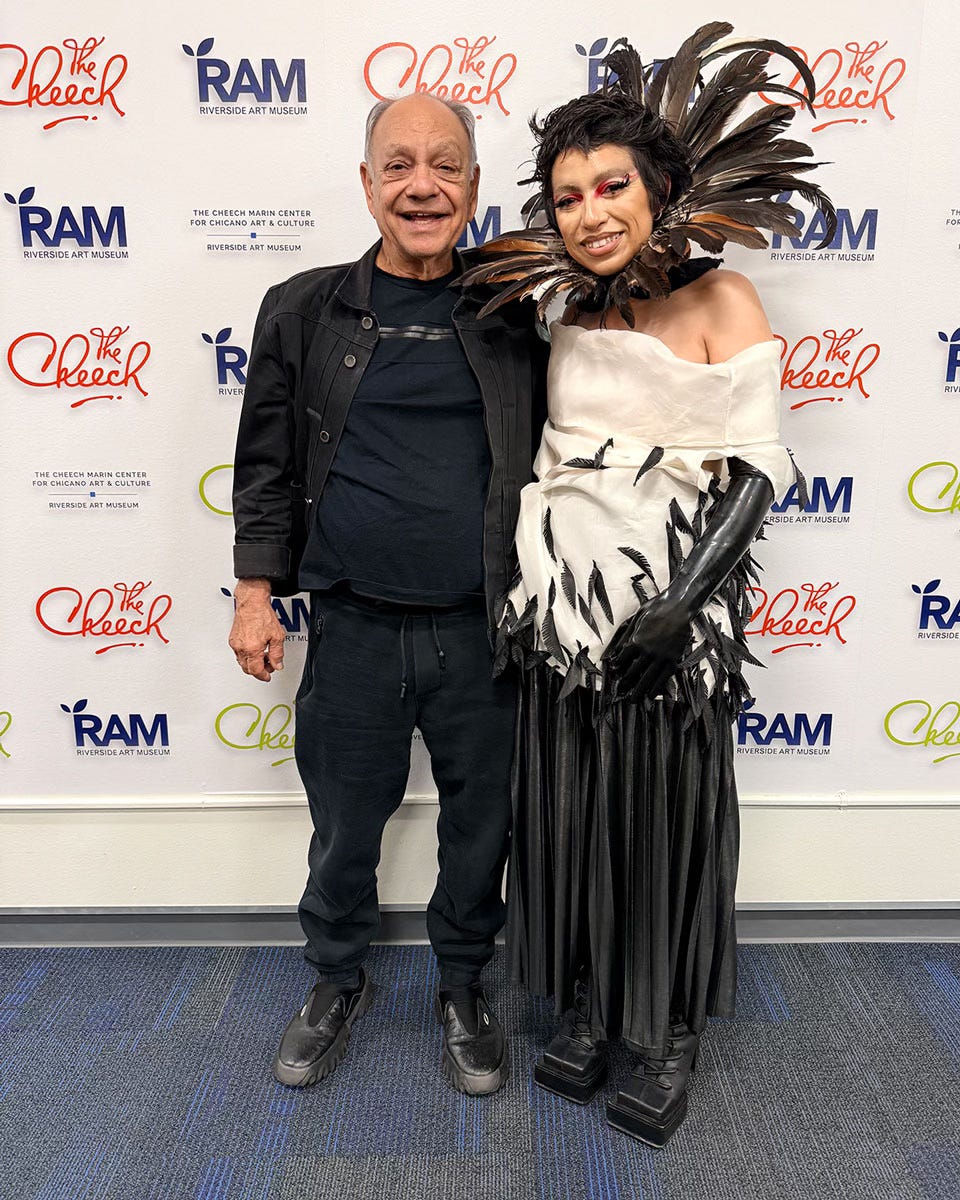
NOTE: This essay emerged from conversations, observations, and moments of listening during and after the opening of Chicano Camera Culture: A Photographic History, 1966–2026 at The Cheech Marin Center of Chicano Art & Culture of the Riverside Art Museum. It reflects on the work that happens after an exhibition opens: presence, communication, and the ongoing labor of helping audiences encounter art in person. I’m grateful to curator Elizabeth Ferrer and artist Yulissa Mendoza for their generosity in sharing their perspectives, and for reading this essay in the spirit in which it was written.
For the first time, an exhibition spans both locations of Riverside Art Museum. RAM’s Julia Morgan Building features the exhibition section titled The Archive, spotlighting four artists whose works explore personal and collective memory through innovative archival practices.
Pre-order the exhibition catalogue for Chicano Camera Culture HERE.
About This Series: MUSE-ings: Notes from the Art World is an occasional essay series by Melissa Richardson Banks reflecting on more than three decades of working with artists, collectors, and museums across the United States. Drawing from personal experiences behind the scenes of exhibitions, collections, and cultural projects, these short reflections explore the relationships, decisions, and moments that shape how art—and artists—find their place in the world.
Author’s Note: The reflections in this essay are my own based on my personal experiences, and do not represent the views of the artists, collectors, museums, or organizations with whom I work or collaborate, past or present.